
Launching a new digital product always comes with one uncomfortable question: how much should you invest before you know whether people actually want it?
Some businesses choose to build a Minimum Viable Product, or MVP, with only the features needed to test the idea. Others prefer to develop a more complete product from day one, believing that a polished experience will make a stronger impression.
Both approaches can work. Both can also become expensive when chosen for the wrong reasons.
When comparing MVP cost vs full product cost, the cheapest option at launch is not necessarily the one that saves the most money over several years. Development cost is only one part of the equation. Maintenance, redesigns, user feedback, infrastructure, integrations, scalability, and missed market opportunities can all affect the final bill.
This guide explains the real financial differences between MVP vs full product development, when each approach makes sense, and how businesses can avoid spending thousands—or even lakhs—on features customers may never use.
What Is the Difference Between an MVP and a Full Product?
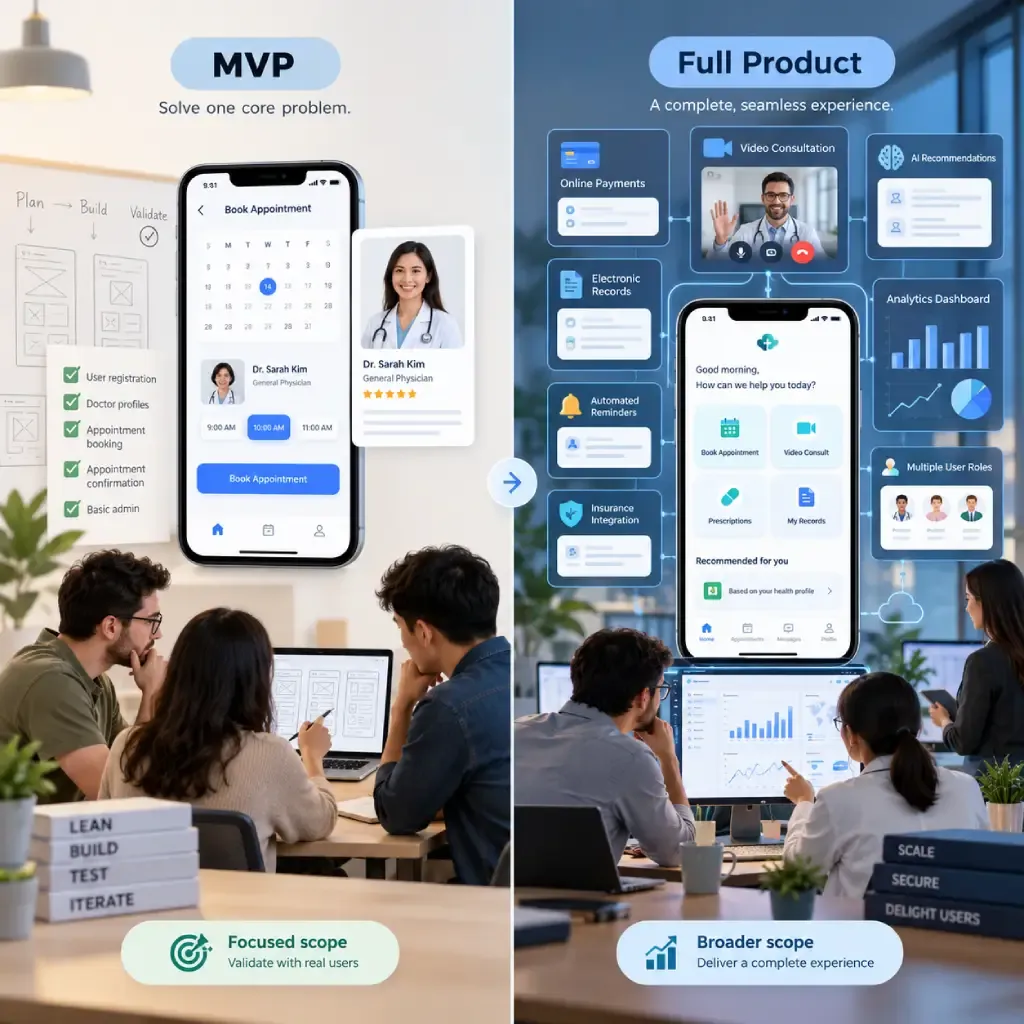
An MVP is the simplest usable version of a product that solves one important problem for its target users.
It is not supposed to be unfinished, unreliable, or poorly designed. A good MVP simply avoids unnecessary complexity.
For example, imagine you want to build an appointment-booking application for clinics.
An MVP might include:
- User registration
- Doctor profiles
- Appointment booking
- Appointment confirmation
- Basic admin management
The full product might eventually include:
- Online payments
- Video consultations
- AI-powered appointment recommendations
- Electronic medical records
- Automated reminders
- Prescription management
- Insurance integration
- Analytics dashboards
- Multiple user roles
The difference is mainly about scope and validation.
The MVP asks:
“Will customers use this solution?”
The full product asks:
“How complete can we make the experience?”
That distinction has a major impact when comparing MVP cost vs full product cost.
MVP Cost vs Full Product Cost: Which Is Cheaper?
Quick Answer
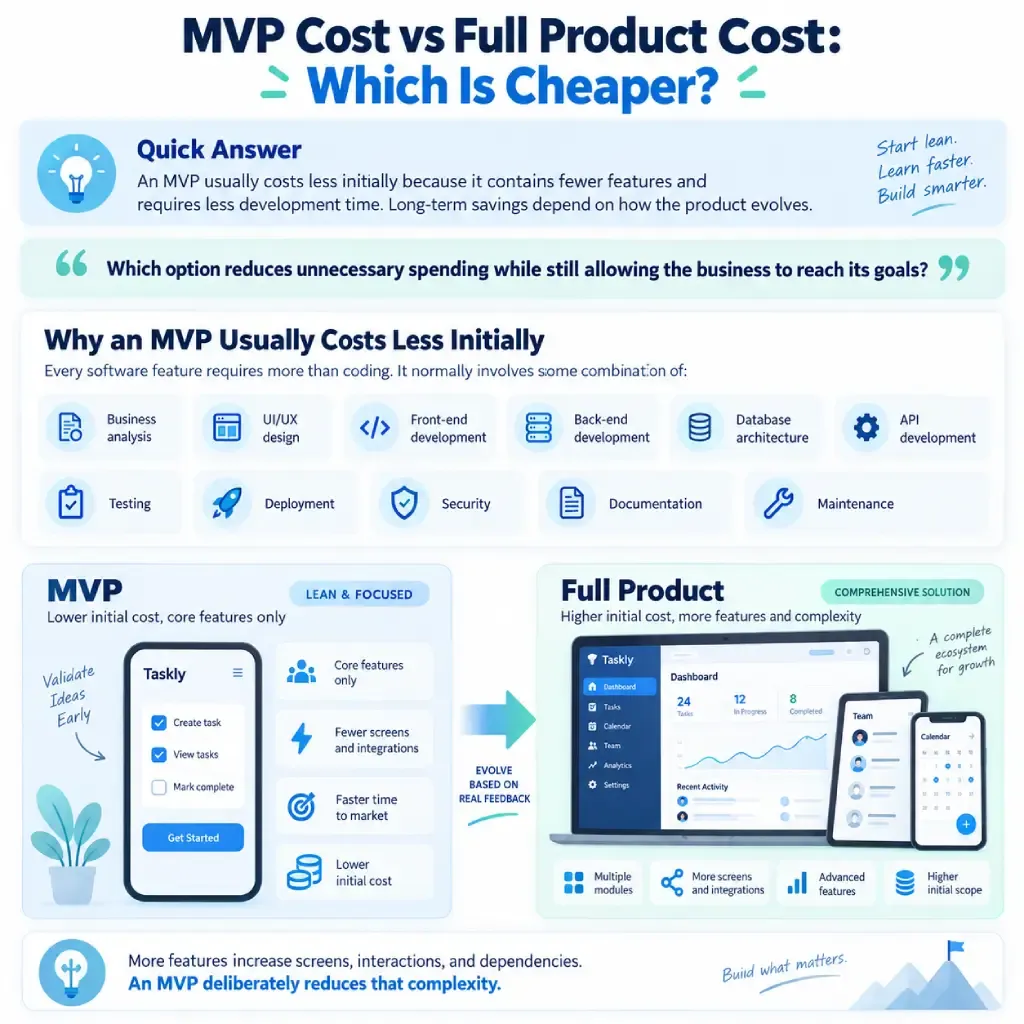
In most cases, an MVP costs less initially because it contains fewer features and requires less development time. However, whether it saves more money in the long run depends on how the product evolves.
An MVP can reduce financial risk by allowing businesses to validate customer demand before investing heavily in development. A full product may make more sense when the business requirements are already well understood and most of the planned features are essential from launch.
The important question therefore isn’t simply:
“Which option is cheaper?”
It is:
“Which option reduces unnecessary spending while still allowing the business to reach its goals?”
Why an MVP Usually Costs Less Initially
Every software feature requires more than coding.
It normally involves some combination of:
- Business analysis
- UI/UX design
- Front-end development
- Back-end development
- Database architecture
- API development
- Testing
- Deployment
- Security
- Documentation
- Maintenance
Adding ten features instead of four does not simply increase the number of screens. It can also increase the number of interactions and dependencies between different parts of the system.
An MVP deliberately reduces that complexity.
Businesses planning an application should therefore define what users genuinely need before committing to the entire feature roadmap. This is particularly important for mobile products, where operating systems, devices, APIs, app-store requirements, and performance considerations can add development complexity. Businesses considering mobile development can explore Think To Share’s mobile app development services to understand the broader development process.
How an MVP Can Save Money in the Long Run
The biggest financial advantage of an MVP is not simply lower development cost.
It is lower decision risk.
1. You Avoid Building Features Nobody Wants
Founders often begin projects with a long list of features they believe customers will appreciate.
Then real users arrive.
Some features become popular. Others barely get opened.
If every idea is developed before the first customer uses the platform, businesses may spend months building functionality that provides little business value.
An MVP allows teams to launch the essential experience first and observe what users actually do.
Real usage data can then guide the next investment.
Instead of saying:
“We think users will need this.”
The business can say:
“Twenty percent of our active users requested this feature.”
That is a much stronger reason to spend development money.
2. Changes Are Cheaper Earlier
Suppose your original product workflow requires users to complete seven steps.
After testing an early version, you discover that most customers abandon the process at step four.
If this is discovered during MVP testing, redesigning the workflow may be manageable.
If the entire platform has already been built around that seven-step journey—with payment integrations, automated emails, dashboards, mobile screens, and analytics connected to it—the change becomes significantly more complicated.
Early validation can therefore prevent expensive redevelopment.
3. You Can Prioritize Revenue-Producing Features
A common problem with full-product development is treating every feature as equally important.
They usually aren’t.
Some features directly help customers buy, subscribe, book, or complete a task. Others are conveniences.
An MVP forces product teams to identify the functionality closest to the business objective.
For an e-commerce application, for example, reliable product discovery, checkout, and payment may matter far more initially than advanced recommendation engines.
If AI will eventually become part of the product, businesses should also consider the ongoing operational costs rather than focusing only on development. Our guide to estimating Claude token costs for e-commerce apps shows why usage-based AI expenses should be considered during product planning.
When a Full Product Can Actually Save More Money
Building an MVP is not automatically the correct decision for every project.
There are situations where reducing the initial scope too aggressively can create additional development work later.
When Requirements Are Already Proven
Imagine a logistics company replacing an existing internal system.
The company already knows that employees need:
- Shipment management
- Driver tracking
- Invoice generation
- Customer accounts
- Reporting
- Document management
These requirements are based on years of operational experience.
Launching an MVP containing only shipment tracking may not provide enough functionality to replace the existing workflow.
In this situation, developing a broader first version may make more financial sense.
Businesses also need to think beyond development costs. Automation can reduce recurring operational expenses after launch. For example, AI can improve workflows across industries where repetitive processing creates significant overhead. Our article on AI cost-cutting in logistics and cargo explores this from an operational perspective.
When Regulations Require Complete Functionality
Industries such as healthcare, fintech, insurance, or enterprise security may require certain capabilities before the platform can be released.
Security controls, permissions, audit logs, consent mechanisms, or compliance workflows cannot always be postponed until “Phase Two.”
In these situations, the minimum viable version may already be relatively comprehensive.
When Your Brand Reputation Depends on the Experience
Established businesses sometimes have different risks than startups.
A startup testing a new concept may have considerable freedom to experiment.
A recognizable brand launching an application to hundreds of thousands of existing customers may need higher levels of performance, infrastructure, accessibility, security, and customer support immediately.
The product can still be developed in phases, but the first release may need to be closer to a production-ready product than a lightweight experimental MVP.
A Practical MVP vs Full Product Development Example
Consider a hypothetical Indian startup building an online marketplace connecting homeowners with verified maintenance professionals.
The original plan includes:
- Customer registration
- Service-provider registration
- Location-based search
- Booking
- Payments
- Live tracking
- In-app chat
- Subscription plans
- Loyalty points
- AI recommendations
- Referral programs
- Advanced analytics
Suppose the founders decide to build everything before launch.
Development takes significantly longer because every feature needs to interact correctly with multiple parts of the application.
But what if customers eventually reveal that their biggest concerns are simply:
- Finding a trustworthy professional
- Seeing availability
- Booking easily
- Paying securely
Features such as loyalty points and AI recommendations may still become useful later, but they were not necessary to prove whether the business idea worked.
An MVP could launch with the four critical workflows first.
After collecting user feedback, the founders might discover that customers care more about repeat bookings than loyalty points.
Development priorities can then change.
That is where the MVP cost vs full product cost discussion becomes more important than the initial quotation alone.
The goal is not just spending less.
The goal is spending money on the right things at the right time.
Hidden Costs Businesses Often Forget
Software budgets often focus heavily on development.
But development is only one part of the product lifecycle.
Maintenance
Every additional feature may require:
- Bug fixes
- Compatibility updates
- Server resources
- API maintenance
- Security monitoring
- Testing
More functionality usually means more long-term maintenance responsibility.
Third-Party Services
Modern applications may depend on:
- Payment gateways
- SMS providers
- Email services
- Cloud platforms
- Mapping APIs
- AI APIs
- Analytics services
Some charge monthly fees. Others charge based on usage.
A feature that appears inexpensive during development can therefore create recurring operating expenses.
Technical Debt
An MVP should be simple, but it should not be badly engineered.
There is an important difference between:
Building fewer features properly
and
Building everything cheaply and planning to fix it later.
Poor architecture can turn an inexpensive MVP into an expensive rewrite.
Using modern development tools effectively can help teams prototype and build faster, but human review and architecture decisions still matter. Businesses exploring newer workflows may find our guide to AI coding and design tools in 2026 useful when evaluating how technology can improve development efficiency.
Opportunity Cost
Spending twelve months developing a complete platform can be risky if a competitor launches a simpler solution in four months and begins attracting customers.
Time is part of product cost.
A slower launch can mean delayed revenue, delayed feedback, and lost market opportunities.
How to Decide Between MVP and Full Product Development
There is no universal answer.
Instead, ask a few practical questions before approving your development roadmap.
What Assumptions Still Need Testing?
If you are unsure whether customers will buy the product, an MVP is usually a logical starting point.
If customers already use a similar internal system and you are simply replacing it, broader development may be justified.
Which Features Directly Deliver the Core Value?
Separate features into three groups:
Essential: The product cannot perform its main purpose without them.
Important: Useful shortly after launch, but not necessary for initial validation.
Optional: Enhancements that can wait until real user demand appears.
Your first release should focus heavily on the first group.
What Happens If the Product Needs to Change?
Products with uncertain user behaviour benefit from flexibility.
If the workflow, pricing model, target audience, or business model may change after launch, spending heavily on a complete platform creates more financial exposure.
Can the Architecture Scale Later?
One common fear is that an MVP will need to be completely rebuilt once it succeeds.
That does not need to happen.
A properly designed MVP can begin with limited functionality while still using a scalable architecture.
The important thing is choosing experienced developers who understand both the immediate requirements and the future roadmap.
If you are evaluating development partners, our guide on how to choose the right AI development company covers many of the technical and commercial questions businesses should ask before signing a contract.
MVP vs Full Product Development: A Better Way to Think About ROI
Instead of asking only how much the first version costs, look at the entire product lifecycle.
Consider:
- Initial development
- Testing
- Infrastructure
- Third-party services
- Maintenance
- Customer feedback
- Redesigns
- New features
- Scaling
- Support
- Revenue generated
An inexpensive product that requires rebuilding after six months may become expensive.
Likewise, a large full product containing dozens of unused features can represent wasted capital.
Strong product planning therefore aims for a balance:
Build enough to deliver real value, but avoid investing heavily in assumptions that have not yet been validated.
That principle applies whether your first version is technically described as an MVP, pilot, beta, Phase One, or production release.
Frequently Asked Questions
Is an MVP always cheaper than a full product?
An MVP is normally cheaper to develop initially because it contains fewer features. However, long-term cost depends on architecture quality, future changes, maintenance, scalability, and how much redevelopment is eventually required.
How many features should an MVP have?
There is no ideal number.
An MVP should contain the minimum set of features required for users to experience the product’s core value. For one application that may mean four features; for another it may mean fifteen.
The question should be whether each feature is essential for validating the product.
Should startups build an MVP first?
For many startups, yes. An MVP can help test customer demand, pricing, user behaviour, and product-market assumptions before a large amount of capital is committed.
However, industries with regulatory or technical requirements may require a more comprehensive initial release.
Can an MVP become the final product?
Yes.
A well-engineered MVP can evolve continuously.
The initial release becomes the foundation, while new features are added based on customer feedback and business priorities.
The key is building the underlying architecture with future development in mind.
What is the biggest mistake when comparing MVP cost vs full product cost?
Looking only at the initial development quote.
Businesses should consider the total cost of ownership, including maintenance, third-party APIs, infrastructure, future redesigns, support, scaling, and the cost of building unnecessary features.
Conclusion: Build What You Need, Then Grow With Evidence
The MVP cost vs full product cost debate should not come down to choosing whichever proposal has the smaller number.
An MVP can save substantial money when a business still needs to validate its idea. It reduces the amount of capital committed before real users provide feedback and allows development priorities to follow actual customer behaviour.
A full product can make more sense when requirements are already proven, regulatory obligations demand broader functionality, or the first release must support a mature operational workflow.
The most cost-effective strategy is therefore simple:
Avoid building features because you think you might need them. Build what solves the immediate problem, measure how people use it, and invest further when the evidence supports it.
Planning a web, mobile, SaaS, or AI-powered product?
Think To Share can help you define the right MVP scope, design a scalable architecture, and create a development roadmap that balances launch speed with long-term cost. Contact our team to discuss your product idea before committing to a full-scale build.
