Today we’re exploring a question that comes up in nearly every AI strategy conversation we have with clients: when it comes to the OpenAI o1 & DeepSeek-R1 comparison, which reasoning model actually deserves your budget?
Both models represent a new generation of AI so-called “reasoning models” that think through problems step by step before answering, rather than generating a response instantly. That extra thinking time makes them remarkably good at math, coding, and complex analysis.
But they arrived from very different worlds. OpenAI o1 is a proprietary, premium-priced model from the best-funded AI lab in the West. DeepSeek-R1 is an open-weight challenger that shook the industry when it launched by matching o1’s performance at a fraction of the cost.
In this guide, we’ll walk through how they compare on benchmarks, pricing, accessibility, and real-world usability so you can make a confident choice for your own projects. Let’s investigate.
What Are Reasoning Models, and Why Do They Matter?
Before we compare the two head-to-head, a quick primer for readers who are newer to this space.
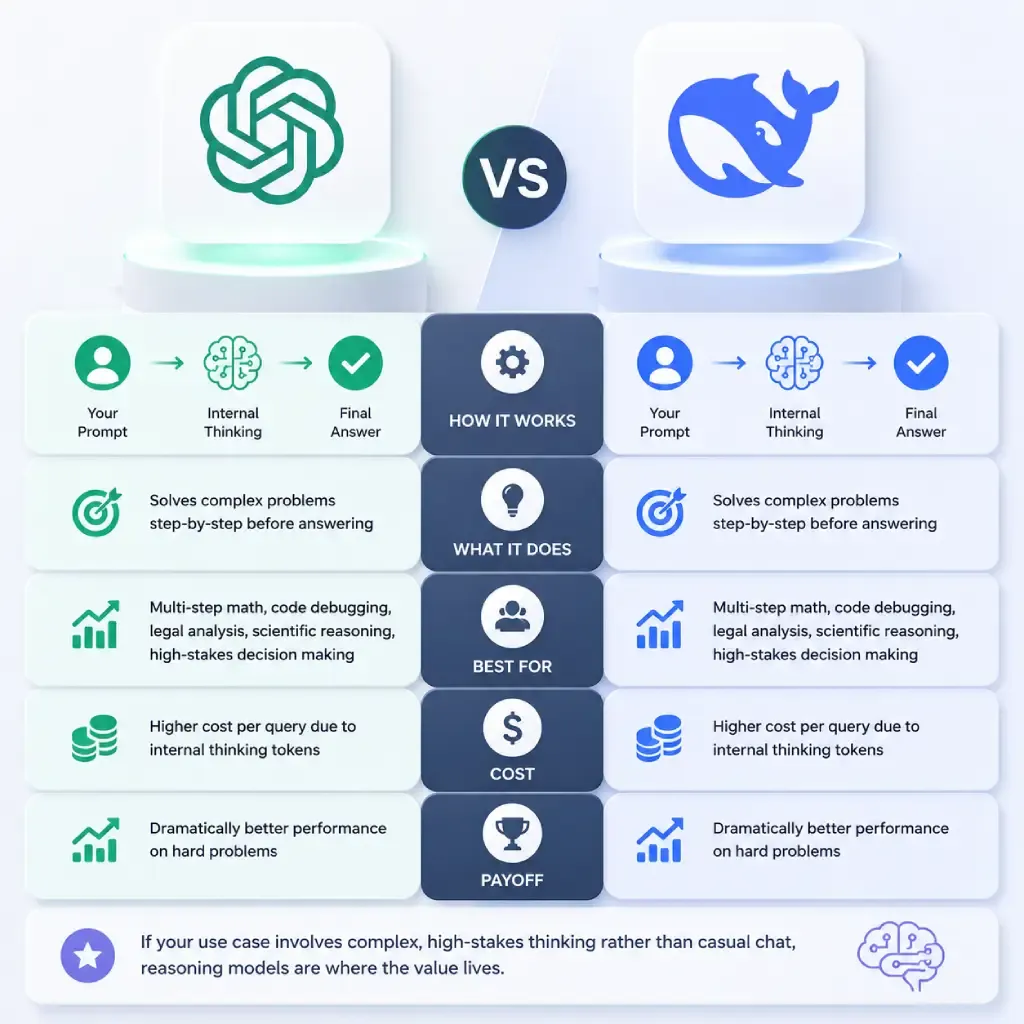
Traditional AI models answer your prompt in a single pass. Reasoning models like o1 and R1 generate internal “thinking tokens” first essentially a hidden scratchpad where the model works through the problem before producing a final answer. Because reasoning models generate internal thinking tokens before producing a final answer, the total cost of a query is often higher than with traditional models, but the payoff is dramatically better performance on hard problems: multi-step math, debugging code, legal analysis, and scientific reasoning.
If your use case involves complex, high-stakes thinking rather than casual chat, reasoning models are where the value lives. (For a broader look at putting AI to work in your business, see our guide to measuring AI ROI.)
OpenAI o1 vs. DeepSeek-R1: Benchmark Performance
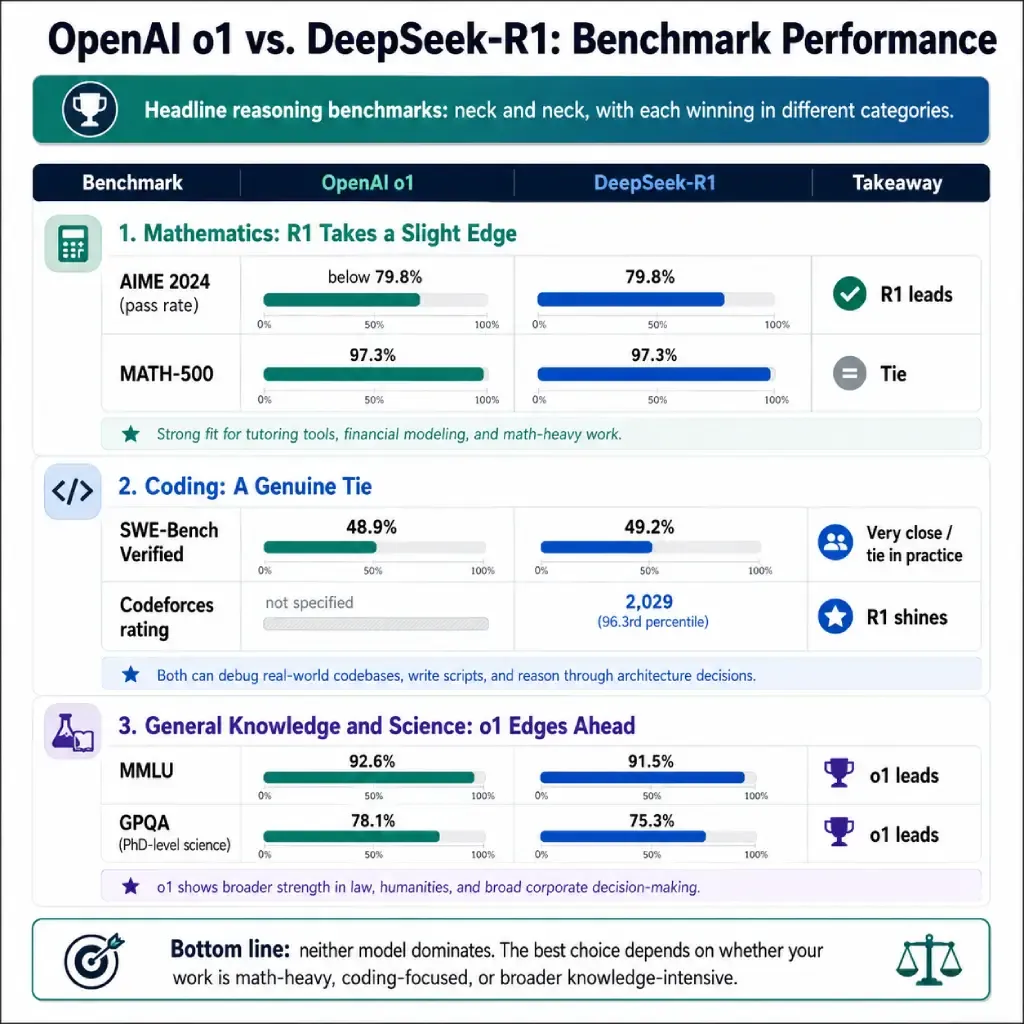
Here’s the direct answer for anyone skimming: on headline reasoning benchmarks, the two models are essentially neck and neck, with each winning in different categories.
Mathematics: R1 Takes a Slight Edge
Math is where DeepSeek-R1 made its name. R1 surpassed o1 on the AIME 2024 competition math benchmark with a 79.8% pass rate, and matched it on MATH-500 at 97.3%. For teams building tutoring tools, financial modeling systems, or anything math-heavy, R1 holds its own against a model that costs dramatically more.
Coding: A Genuine Tie
Software engineering is close enough to call a draw. R1 scored 49.2% on SWE-Bench Verified versus 48.9% for o1, and achieved a Codeforces rating of 2,029 the 96.3rd percentile of competitive programmers. In practice, both models can debug real-world codebases, write functional scripts, and reason through architecture decisions. Some teams still prefer o1 for agentic coding tasks where the AI must independently debug across multiple files, but for everyday development work, the gap is negligible.
General Knowledge and Science: o1 Edges Ahead
Where o1 retains an advantage is breadth. On MMLU, which tests general multitask knowledge, o1 scores around 92.6% versus R1’s 91.5%, and on GPQA PhD-level science questions o1 leads at roughly 78.1% to 75.3%. If your workload spans law, humanities, and broad corporate decision-making, o1’s versatility may matter.
The honest takeaway: neither model dominates. The real differences show up in the next two sections.
The Price Gap Is Enormous And It Changes Everything
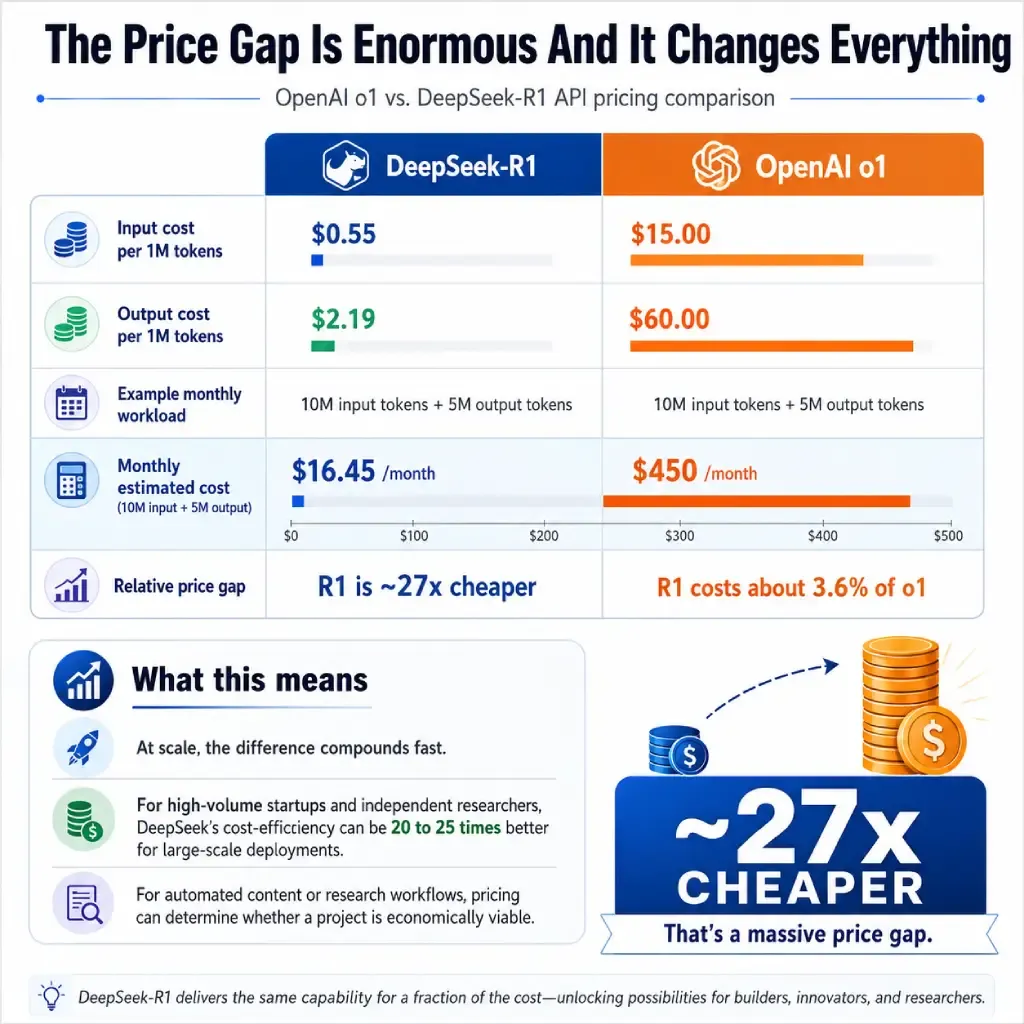
This is where the OpenAI o1 vs. DeepSeek-R1 comparison stops being close.
DeepSeek R1’s API costs approximately $0.55 per million input tokens and $2.19 per million output tokens. OpenAI o1 costs approximately $15.00 per million input tokens and $60.00 per million output tokens. That makes R1 roughly 27 times cheaper than o1 about 3.6% of o1’s cost.
Let’s make that concrete. Imagine your application processes 10 million input tokens and generates 5 million output tokens per month:
- DeepSeek-R1:roughly $16.45/month
- OpenAI o1:roughly $450/month
At scale, that difference compounds fast. For high-volume startups and independent researchers, DeepSeek’s cost-efficiency is often 20 to 50 times better for large-scale deployments. If you’re automating content workflows like the ones we cover in our AI quote generation guide that pricing gap determines whether a project is economically viable at all.
Open Weights vs. Proprietary: The Accessibility Divide
Price isn’t the only structural difference.
DeepSeek-R1: Open, Flexible, Self-Hostable
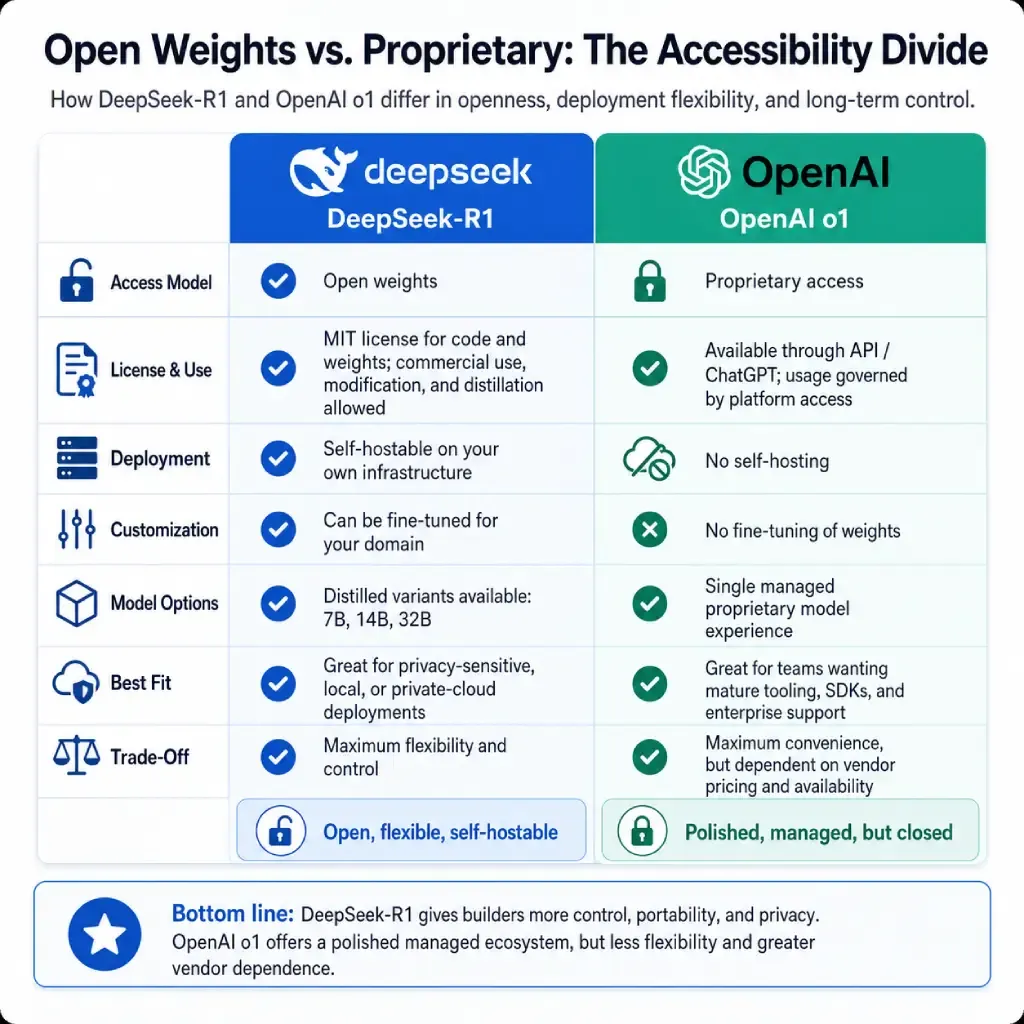
R1 ships under an MIT license covering both code and weights, permitting commercial use, modification, and even distillation and it became the most-downloaded open-weight model on Hugging Face. That means you can run it on your own infrastructure, fine-tune it for your domain, and never worry about a vendor changing terms.
There’s also a family of smaller options. DeepSeek offers six distilled models fine-tuned on synthetic data derived from R1 itself, varying in size to target specific use cases for developers who need lighter, faster models. The distilled variants (7B, 14B, 32B) are practical for local or private cloud deployment using tools like Ollama a genuine advantage for privacy-sensitive industries.
OpenAI o1: Polished but Closed
o1 is proprietary and only accessible via API or the ChatGPT interface. You get OpenAI’s mature tooling, SDKs, and enterprise support but no self-hosting, no fine-tuning of the weights, and full dependence on OpenAI’s pricing and availability. Notably, OpenAI itself now recommends moving off o1 as its newer o-series models have superseded it, which raises real questions about building long-term projects on it.
Which Model Should You Choose?
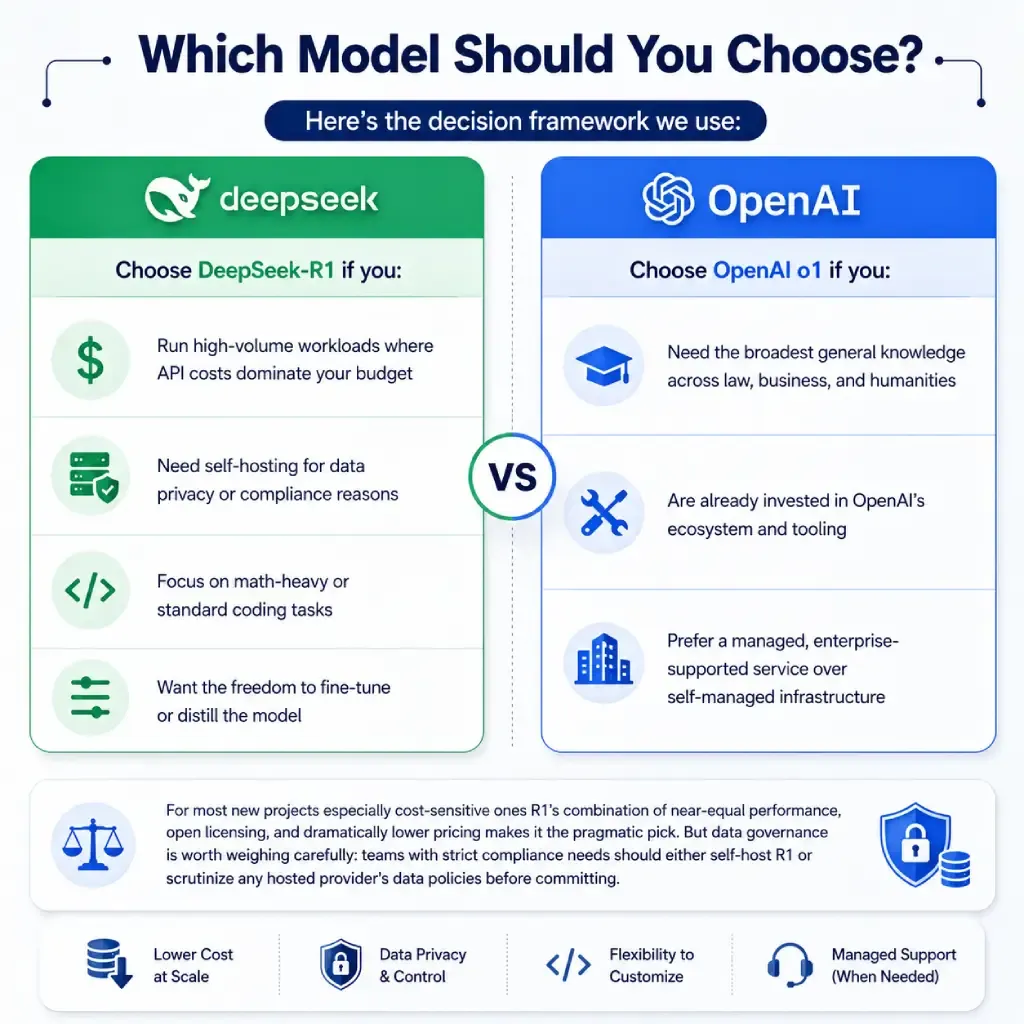
Here’s the decision framework we use:
Choose DeepSeek-R1 if you:
- Run high-volume workloads where API costs dominate your budget
- Need self-hosting for data privacy or compliance reasons
- Focus on math-heavy or standard coding tasks
- Want the freedom to fine-tune or distill the model
Choose OpenAI o1 if you:
- Need the broadest general knowledge across law, business, and humanities
- Are already invested in OpenAI’s ecosystem and tooling
- Prefer a managed, enterprise-supported service over self-managed infrastructure
For most new projects especially cost-sensitive ones R1’s combination of near-equal performance, open licensing, and dramatically lower pricing makes it the pragmatic pick. But data governance is worth weighing carefully: teams with strict compliance needs should either self-host R1 or scrutinize any hosted provider’s data policies before committing.
Frequently Asked Questions
Is DeepSeek-R1 really as good as OpenAI o1?
On most reasoning benchmarks, yes R1 outperforms o1 on mathematical reasoning tasks like MATH-500 and AIME 2024, and performs comparably on software engineering tasks. o1 keeps a modest lead in general knowledge and graduate-level science questions.
How much cheaper is DeepSeek-R1 than OpenAI o1?
Roughly 27x cheaper via API about $0.55/$2.19 per million input/output tokens versus $15/$60 for o1. That works out to under 4% of o1’s cost for equivalent usage.
Can I run DeepSeek-R1 on my own hardware?
Yes. The full model requires serious GPU resources, but the distilled 7B–32B variants run locally on consumer or enterprise hardware, and the MIT license permits commercial use.
Is OpenAI o1 still worth using in 2026?
It remains capable, but OpenAI’s newer reasoning models have superseded it, and its pricing hasn’t changed. For new builds, evaluate current-generation models or R1 first.
Which model is safer for sensitive business data?
Self-hosting R1 gives you full control over your data, which no API-only model can match. If self-hosting isn’t feasible, compare each provider’s data retention and training policies directly.
The OpenAI o1 vs. DeepSeek-R1 comparison ultimately isn’t about which model is “smarter” they’re within a point or two of each other on most benchmarks. It’s about economics and control. R1 delivers comparable reasoning at a fraction of the price, with the freedom of open weights; o1 offers polish and breadth inside a closed, premium ecosystem.
Ready to put reasoning models to work in your business? The team at Think To Share helps companies choose, integrate, and scale the right AI tools for real ROI. Reach out today for a consultation and let’s build something that thinks as hard as you do.
