
If you have started asking development companies for quotes, you may already have noticed something confusing: two teams can look equally capable on paper and still quote very different prices.
Location is one reason.
A company building the same mobile app in the United States and India may end up with very different development budgets, even when the technology and basic feature list are similar.
So, how much does it cost to develop an app in USA vs India in 2026?
There isn’t one fixed number. Current Clutch data shows that mobile app development companies overall commonly charge around $25–$49 per hour. Its 2026 location data lists India at below $25 per hour on average, while individual Indian development companies commonly appear in both the under-$25 and $25–$49 brackets. U.S.-based product agencies can be considerably more expensive, with some U.S. listings citing roughly $70–$120 per hour for mid-level talent and $120-$200 for senior talent.
That difference can become substantial once a project stretches across several months.
But price alone doesn’t tell you where you should build your app. You also need to look at the team, communication, technical experience, product complexity, QA process, and what exactly is included in the quote.
Let’s break it down.
How Much Does It Cost to Develop an App in USA vs India?
Here’s the short answer.
Mobile app development in India can often cost considerably less than hiring a comparable U.S.-based development team because development rates are lower. However, the final budget depends much more on the app’s scope than on geography alone.
Current market listings give us a useful reference point:
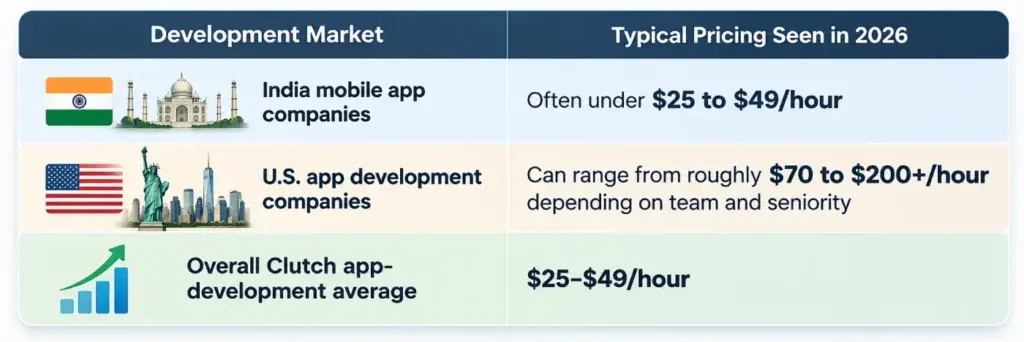
Clutch’s broader 2026 pricing data says most reviewed mobile app projects fall between $10,000 and $49,999, although its calculated average project cost is higher because large and complex applications pull the average upward.
For U.S. agencies specifically, Clutch notes that MVP projects may fall around $30,000-$75,000, while larger B2C or B2B products may reach $80,000-$250,000 or more.
Indian agency listings show a much wider low-cost entry point. Many providers list rates below $25 or between $25 and $49 per hour, with individual agency project minimums starting from a few thousand dollars.
Those aren’t guaranteed quotes. Think of them as useful market reference points.
Your actual quote starts with what you’re building.
Why Is App Development Pricing in USA vs India So Different?
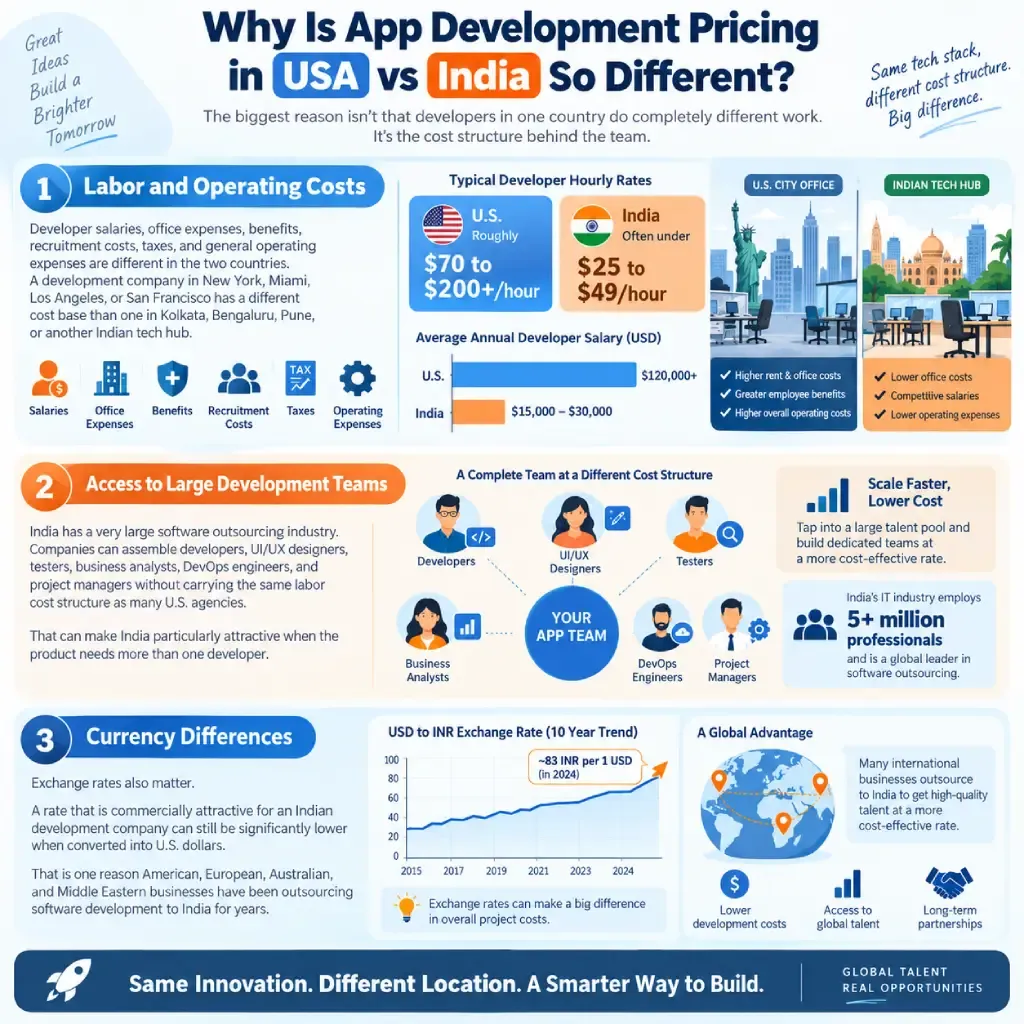
The biggest reason isn’t that developers in one country are doing completely different work.
It is the cost structure behind the team.
Labor and Operating Costs
Developer salaries, office expenses, benefits, recruitment costs, taxes, and general operating expenses are different in the two countries.
A development company in New York, Miami, Los Angeles, or San Francisco has a different cost base from one operating in Kolkata, Bengaluru, Ahmedabad, Pune, or another Indian technology hub.
Those costs eventually appear in the hourly or project rate.
This is why app development pricing USA vs India can look dramatically different even when both companies propose React Native, Flutter, Swift, Kotlin, Laravel, Node.js, AWS, or essentially the same technology stack.
Access to Large Development Teams
India has a very large software outsourcing industry. Companies can assemble developers, UI/UX designers, testers, business analysts, DevOps engineers, and project managers without carrying the same labor cost structure as many U.S. agencies.
That can make India particularly attractive when the product needs more than one developer.
Currency Differences
Exchange rates also matter.
A rate that is commercially attractive for an Indian development company can still be significantly lower when converted into U.S. dollars.
That is one reason American, European, Australian, and Middle Eastern businesses have been outsourcing software development to India for years.
What Actually Determines Your Mobile App Development Cost?
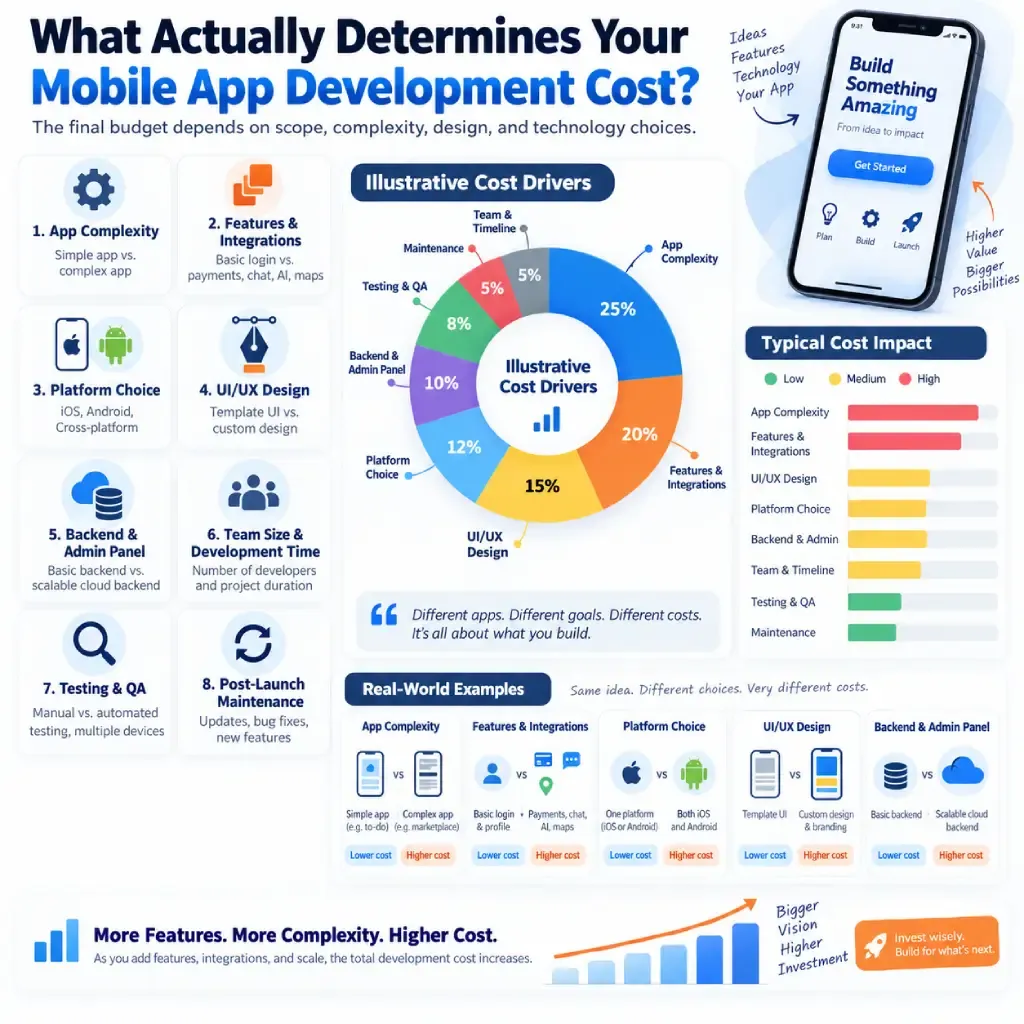
Geography matters, but it isn’t the biggest mistake founders make when budgeting.
The bigger mistake is comparing quotes without comparing scope.
A $15,000 proposal and a $60,000 proposal may not actually be proposals for the same product.
Here are the areas that usually move the number.
1. App Complexity
A simple app might include:
- Registration and login
- User profiles
- Basic content
- Push notifications
- Standard admin panel
Compare that with an application containing:
- Live location tracking
- Real-time messaging
- Subscription payments
- Multiple user roles
- AI recommendations
- Video calling
- Marketplace functionality
- Complex analytics
- External APIs
- Advanced security requirements
The second product isn’t just “an app with more features.” Each feature creates design, backend, testing, security, and integration work.
For example, a logistics application requiring real-time routing and location data is naturally more involved than a straightforward informational app. Our route planner app development guide shows how quickly maps, route optimization, APIs, and operational workflows can add complexity.
2. Native vs Cross-Platform Development
Do you need separate native Android and iOS applications?
Or can you use Flutter or React Native and maintain much of the app through one codebase?
For many business applications, cross-platform development can reduce duplicated work.
Native development may still make sense when you need deep device integration, highly specialized performance, graphics-heavy functionality, or platform-specific features.
The cheapest technology choice isn’t automatically the right one. The goal is to avoid paying for complexity your users don’t need.
3. UI and UX Design
Ten straightforward screens and ten highly interactive screens are not the same job.
Custom animation, advanced navigation, unusual interactions, multiple prototypes, and extensive user testing all require additional design and development time.
Good UX is worth budgeting for, though. Saving money by making the product frustrating to use rarely works out well.
We have covered this in more detail in our guide to user-friendly app development.
4. Backend Development
A mobile app is often only the visible part of a much larger system.
You may also need:
- APIs
- Database architecture
- Admin dashboard
- Cloud hosting
- Authentication
- File storage
- Reporting
- Permissions
- Payment processing
- Notification systems
A relatively simple mobile interface can therefore have a surprisingly substantial backend.
5. Third-Party Integrations
Stripe, Google Maps, Firebase, Twilio, payment gateways, CRMs, ERP systems, social logins, AI APIs, analytics platforms, and banking APIs can all save development time.
They can also add integration work and recurring costs.
Before approving a quote, ask which third-party services the application will depend on and what those services may cost after launch.
USA vs India: A Practical Example
Imagine a startup needs a cross-platform application with:
- User registration
- Profiles
- Online payments
- Push notifications
- Admin dashboard
- Basic reporting
- One external API
- Android and iOS deployment
The feature list doesn’t change simply because the development company changes location.
What changes is the cost of the team delivering it.
If a U.S. product team bills toward the higher end of the U.S. market and an experienced Indian team bills below $50 per hour, the difference over several months can easily become tens of thousands of dollars.
That saving can be useful.
But only if the lower-cost team delivers correctly.
Saving $40,000 on development and then spending months rebuilding unstable code isn’t a saving.
That is why businesses comparing app development pricing USA vs India should evaluate:
- Previous projects
- Client reviews
- Technical expertise
- Communication
- QA process
- Project management
- Code ownership
- Documentation
- Post-launch support
Hourly rate should be one column in your comparison sheet, not the entire sheet.
How Can You Reduce App Development Costs Without Cutting Quality?
The easiest way to reduce development costs is usually not negotiating another $2 off the developer’s hourly rate.
It is reducing wasted development.
Start With an MVP
Don’t build every idea in version one.
Build the smallest useful version that solves the central problem, put it in front of users, and learn from what happens.
A feature that never gets built costs far less than a feature that takes four weeks to build and nobody uses.
For more practical ideas, see our guide on ways to reduce mobile app development costs.
Define the Scope Before Development
Changing requirements every week is expensive.
You don’t need a 200-page specification before starting, but you should know:
- Who will use the app
- What each user can do
- Which features belong in version one
- Which integrations are required
- What the admin needs to control
- Which platforms you are targeting
A proper discovery phase makes the quote more useful and reduces unpleasant surprises later.
Understanding the full app development life cycle can also help you see where planning, design, development, QA, launch, and maintenance fit into the budget.
Think Beyond the Initial Development Quote
Your app doesn’t stop costing money the day it appears in the App Store.
You may still have:
- Server bills
- API charges
- Bug fixes
- OS compatibility updates
- Security updates
- New features
- Monitoring
- App Store and Play Store requirements
When comparing proposals, ask for development and post-launch estimates.
Our 2026 mobile app development cost estimation guide goes deeper into the individual elements that should be included in that calculation.
Should a U.S. Company Outsource App Development to India?
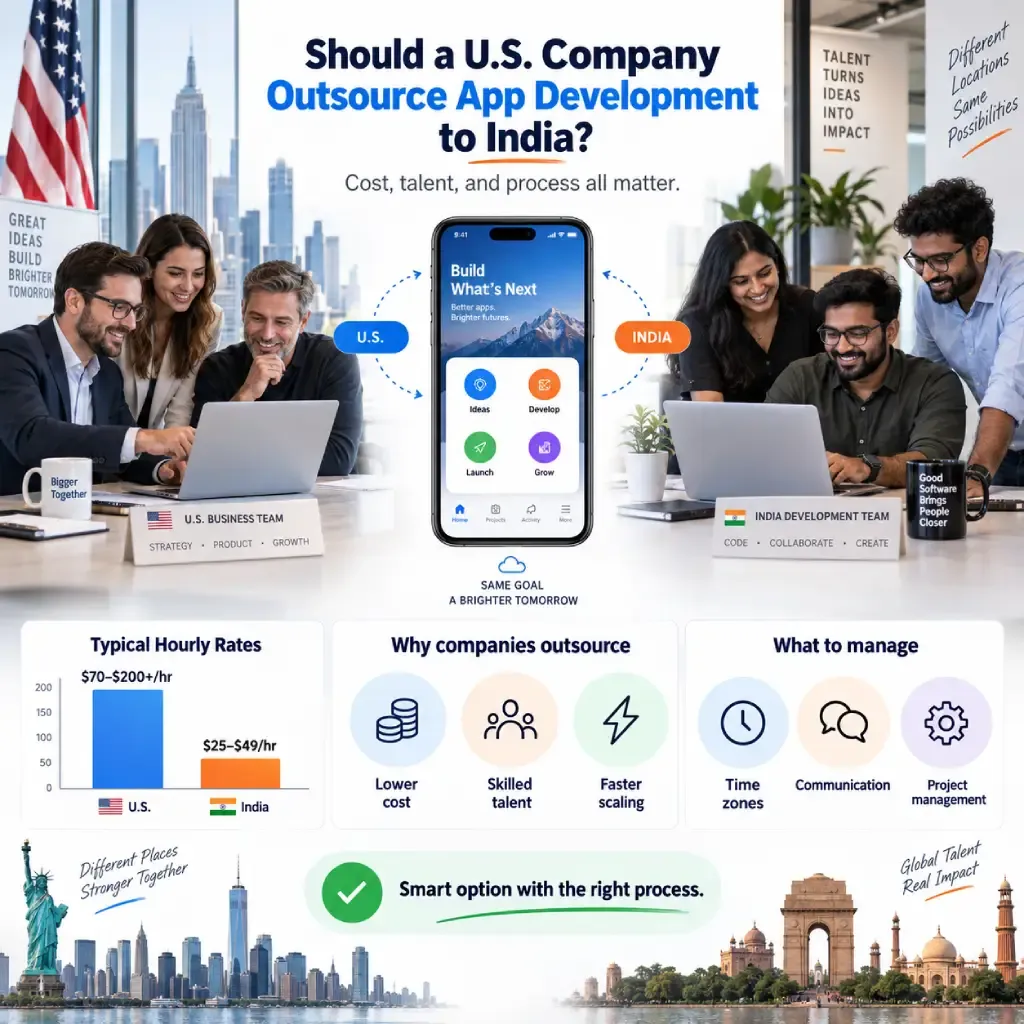
It can make sense when the company has a defined product idea and finds an Indian development partner with a proven delivery process.
Cost is usually the obvious advantage, but there are trade-offs to manage.
Time zones can be useful because development continues while the U.S. team is offline, but they can also make meetings harder. Communication standards need to be clear. Requirements need to be documented. Someone needs ownership of priorities and approvals.
Ask practical questions before signing:
Who will be my daily contact?
Will I speak directly with developers?
How often will I receive builds?
Who owns the source code?
Where will the code be stored?
How are bugs tracked?
What happens during UAT?
What happens after launch?
Those questions will tell you more about the likely project experience than a polished sales presentation.
Clutch’s 2026 guidance similarly notes that offshoring is widely used to access lower development rates and that many offshore companies already have substantial experience working with international clients.
FAQ: Mobile App Development Cost in USA vs India
How much does it cost to develop an app in USA vs India in 2026?
There is no single fixed price. U.S. development teams can range from roughly $70 to $200+ per hour depending on seniority and agency structure, while Indian mobile development companies commonly list rates below $25 or between $25 and $49 per hour. Scope, complexity, team size, and integrations ultimately determine the project total.
Is mobile app development cheaper in India than in the USA?
Generally, yes. Development rates in India are usually lower than those charged by U.S.-based product teams. Lower rates do not automatically mean lower quality, though. Portfolio, engineering standards, QA, communication, and project management still need to be evaluated.
Why do app development quotes vary so much?
Two companies may be estimating different numbers of screens, APIs, user roles, backend modules, QA hours, design work, or post-launch support. Ask for a feature-by-feature scope before comparing prices.
Should I choose the cheapest mobile app developer?
Usually not based on price alone. A low quote can be valuable when it comes from an efficient team, but it can also mean missing requirements, limited testing, junior resources, or work that was simply left out of the estimate.
Is React Native or Flutter cheaper than native development?
It can be. Cross-platform frameworks let teams reuse much of the same code across Android and iOS, which can reduce development effort for suitable projects. The right choice still depends on performance needs, device integrations, and the long-term product roadmap.
Final Thoughts
So, how much does it cost to develop an app in USA vs India?
India will often give you access to lower development rates, while U.S. agencies commonly operate at significantly higher hourly rates. On a project lasting several months, that difference can have a major effect on the final budget.
But choosing a development location shouldn’t become a race to find the lowest hourly number.
Start with the product.
Decide what the first version actually needs. Define the scope. Compare technical approaches. Check real work. Speak with the people who will be working on the project. And make sure every proposal covers the same thing before comparing the final price.
If you’re planning a new mobile product and want a realistic estimate rather than a generic package price, Think To Share can help you break the idea into features, technology, development stages, and a practical budget for Android, iOS, or cross-platform development.
